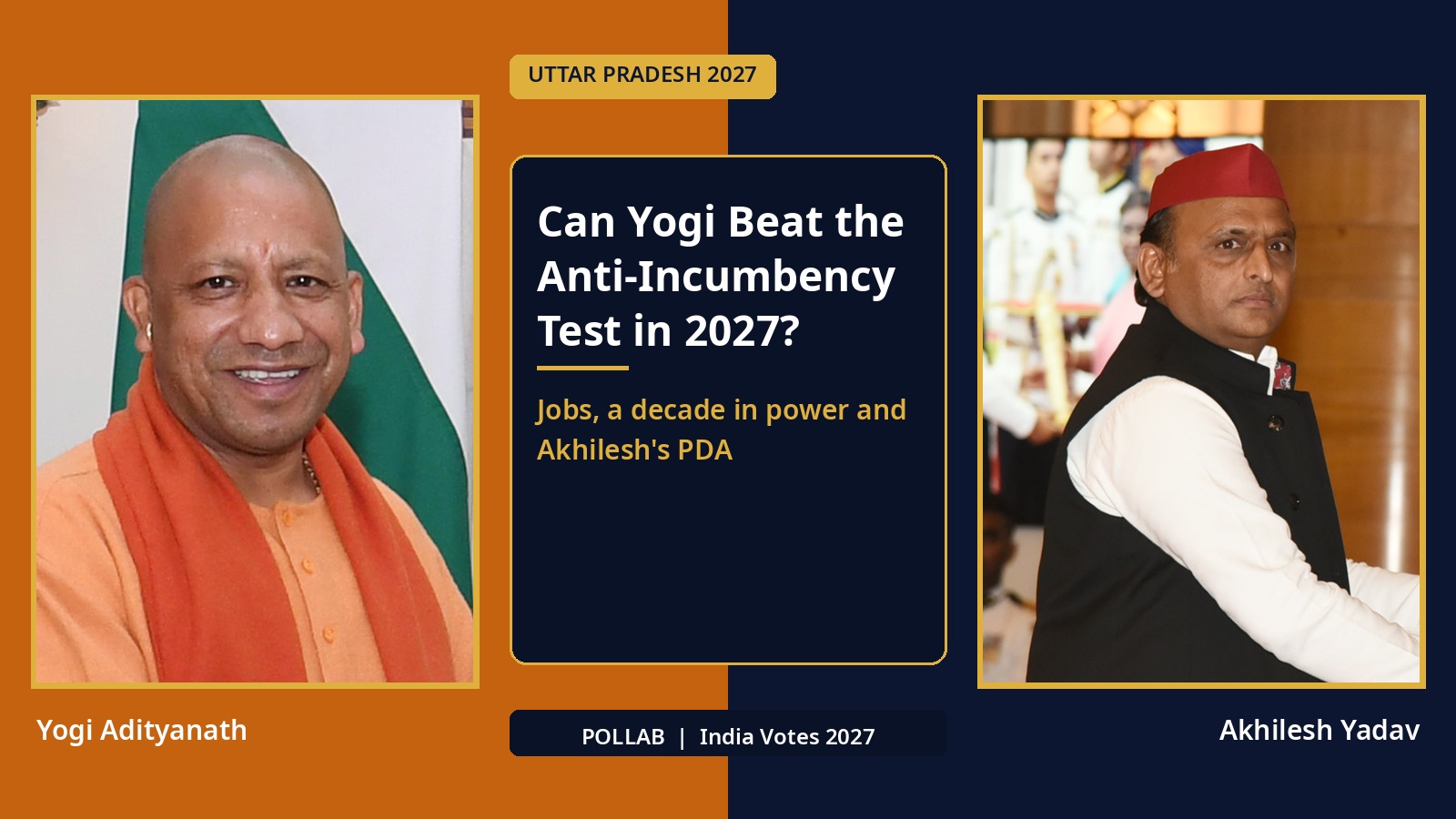
Unemployment, a decade of governance fatigue, and Akhilesh Yadav’s PDA strategy are emerging as the real challenges for Yogi Adityanath. Can the BJP turn its political strengths into another electoral victory in Uttar Pradesh?
Beyond Ayodhya, the real electoral battle begins
In Uttar Pradesh politics, Ayodhya is more than a religious landmark. It is one of the most defining political symbols in the BJP’s journey over the past several decades. The construction of the Ram Temple represents a historic milestone for the party, built on years of political mobilisation, public sentiment and a sustained ideological campaign.
However, allegations and controversies surrounding the management of temple donations have put the BJP in an uncomfortable position. The issue has raised sensitive questions about institutional accountability, public trust and the handling of devotees’ contributions.
While the controversy has created a political challenge, the BJP government has attempted to navigate it through investigations, institutional measures and a broader shift towards its governance narrative.
But as Uttar Pradesh moves towards the 2027 Assembly elections, a bigger question is emerging:
Can the Yogi government overcome the moderate anti-incumbency that naturally builds up after a decade in power?
That is likely to be the real electoral battle for the BJP.
Can Yogi overcome a decade of governance fatigue?
Ten years of BJP rule in Uttar Pradesh have brought both political stability and the inevitable accumulation of public expectations and dissatisfaction.
The Yogi government has built its political narrative around law and order, infrastructure development, investment promotion and welfare delivery. These remain important strengths for the incumbent government.
Yet, unemployment, inflation, recruitment-related grievances, dissatisfaction over government examinations and the performance of local legislators could become significant electoral vulnerabilities.
Recent survey reports suggest a political paradox: Yogi Adityanath continues to enjoy considerable leadership appeal, while unemployment and dissatisfaction with local representatives remain important concerns among voters.
The BJP’s challenge, therefore, is not necessarily to defend every sitting MLA, but to separate the popularity of the Chief Minister from local anti-incumbency.
Candidate reshuffles, constituency-level performance reviews, better welfare outreach and a credible employment agenda could help the party manage this challenge.
However, replacing unpopular candidates alone may not be sufficient. The government will need to address the reasons behind public dissatisfaction rather than merely reposition its electoral machinery.
Siddaramaiah’s AHINDA and Akhilesh’s PDA: Will the social coalition strategy work in UP?
In Karnataka, Siddaramaiah’s AHINDA political framework — representing minorities, backward classes and Dalits — helped establish a distinctive social coalition in state politics.
Drawing inspiration from the broader politics of social representation, Akhilesh Yadav is attempting to build a similar political framework in Uttar Pradesh through his PDA formula — Pichhde, Dalit, Alpsankhyak (Backward Classes, Dalits and Minorities).
PDA is not merely an electoral slogan. It is an attempt to centre political discourse around social representation, caste census, equitable distribution of opportunities and political participation.
The Samajwadi Party’s gains in the 2024 Lok Sabha elections strengthened the political relevance of this strategy. Akhilesh Yadav is now attempting to expand the framework ahead of the 2027 Assembly elections.
The SP has been increasingly positioning issues such as employment, caste census, social justice, representation in public contracts and economic support for unemployed youth within its broader political narrative.
However, AHINDA’s political success in Karnataka cannot automatically be replicated through PDA in Uttar Pradesh.
The social structures of the two states are considerably different. In Uttar Pradesh, Yadavs, other OBC communities, Dalit sub-groups, Muslims and several other social communities have different political aspirations, local rivalries and leadership interests.
For PDA to become an effective electoral coalition, Akhilesh Yadav will need to overcome three major challenges:
Beyond electoral arithmetic: The coalition must translate into meaningful political representation and participation, rather than remain an election-time mobilisation strategy.
Overcoming the Yadav-centric perception: The SP must convince other backward communities and Dalit groups that PDA offers equal political importance and representation.
Building an economic narrative: Employment, education, healthcare, inflation and social justice must form a coherent policy agenda rather than merely a political slogan.
If PDA successfully consolidates these communities into a cohesive voting bloc, it could pose a serious challenge to the BJP.
But if the coalition remains fragmented or lacks local leadership and organisational cohesion, the BJP could continue to benefit from its broader social coalition, Hindutva narrative and welfare outreach.
BJP’s prospects in 2027: Strong, but far from guaranteed
It would be premature to describe the BJP as a weak contender in Uttar Pradesh. Yogi Adityanath’s leadership appeal, the party’s organisational strength, the RSS network, coordination with the central leadership and welfare beneficiaries remain significant electoral assets.
Several recent survey reports have also indicated favourable political signals for Yogi’s leadership. However, survey projections cannot be treated as guaranteed election outcomes.
The BJP’s prospects in 2027 will largely depend on:
Maintaining public confidence in Yogi Adityanath’s leadership.
Addressing unemployment with credible solutions.
Managing constituency-level anti-incumbency.
Maintaining social balance across OBC, Dalit, Brahmin, Thakur and other communities.
Countering Akhilesh Yadav’s PDA strategy with an effective social coalition.
Ensuring that welfare schemes and development projects translate into visible benefits for voters.
The conclusion: A contest between two political models
The Ayodhya fund controversy may have created a sensitive political moment for the BJP, but it alone is unlikely to determine the outcome of the 2027 elections. Navigating the controversy is one phase of the political battle. Rebuilding and sustaining public confidence after a decade in power is another.
Yogi Adityanath remains a formidable political leader in Uttar Pradesh. But unemployment, local dissatisfaction, caste-based political realignment and Akhilesh Yadav’s PDA strategy are real challenges that cannot be ignored.
Yogi’s electoral success in 2027 may not depend solely on the strength of Hindutva politics. It could depend equally on his ability to translate political strength into tangible solutions to everyday public concerns.
The contest in Uttar Pradesh is increasingly shaping up as a battle between two political models.
On one side stands Yogi Adityanath’s governance narrative built around Hindutva, law and order, infrastructure and welfare.
On the other stands Akhilesh Yadav’s attempt to construct a broader social coalition through political representation, social justice and PDA.
Which of these two political narratives resonates more deeply with the aspirations of Uttar Pradesh voters will ultimately determine the direction of the 2027 Assembly elections.
Cover portraits: Yogi Adityanath (President’s Secretariat) and Akhilesh Yadav (President’s Secretariat, cropped), via Wikimedia Commons, licensed under GODL-India.