Jensen Huang: From Scandal to Comeback — When a Company Can't Afford to Lose Its Visionary
Eleven days of turbulence, allegations, resignation, political intervention and a spectacular comeback. Jensen Huang's return to Nvidia may have become one of the most extraordinary demonstrations of a CEO's value in the AI era.
The corporate world has witnessed dramatic CEO exits before. But few have unfolded with the speed, controversy and sheer market impact of Jensen Huang's turbulent November at Nvidia.
In barely two weeks, the man who became the face of the global artificial intelligence revolution went from being at the centre of a deeply uncomfortable scandal to being welcomed back as though his absence had threatened an entire industry. His return was not merely a corporate decision. It was a market event, a political moment and perhaps a statement about how indispensable a visionary founder can become to the company he builds.
The fall: A personal scandal becomes a corporate crisis
The storm began with reports linking Huang to Alice Huang, a Singapore-based business executive associated with Megaspeed, amid allegations that she had connections to Chinese intelligence. The allegations raised concerns not only about Huang's personal conduct but also about Nvidia's commercial relationships, access to advanced AI chips and the sensitive geopolitical environment surrounding US-China technology competition.
The alleged intelligence links have not been established as fact. Chinese officials have denied the espionage allegations, and US authorities have not publicly established that sensitive information was compromised.
The controversy became even more damaging when reports emerged of additional alleged relationships involving Nvidia employees, including a senior executive. Huang acknowledged infidelity, apologised to his family and found himself facing a crisis that was rapidly transcending the personal realm.
The Nvidia board's position initially appeared uncompromising. On November 12, Huang stepped down. The company was thrown into uncertainty, and its leadership transition suddenly became a question of whether Nvidia could continue to command investor confidence without the man who had shaped its identity for more than three decades.
The situation was compounded by concerns over Nvidia's China business, export-control compliance, corporate disclosures and the possibility of investigations. Shareholder litigation and political scrutiny added further pressure. What began as a personal controversy had become a test of corporate governance and national-security oversight.
The comeback: The board changed its mind
The dramatic twist came on November 23.
After initially signalling that Huang would not be reinstated, Nvidia's board reversed course and unanimously restored him as president, CEO and board director. The board cited discussions with Huang, his candour and input from senior US government officials, stating that it was confident his return posed no national-security risk. Its investigations, however, were not closed.
President Donald Trump openly supported Huang's return and acknowledged his involvement in the process. Support also reportedly came from influential figures across the technology industry and investment community.
The reversal was extraordinary. A CEO who had left amid a controversy serious enough to unsettle investors was brought back in less than two weeks, with the board effectively acknowledging that his leadership was difficult to replace.
The market's verdict: A 31.5% surge
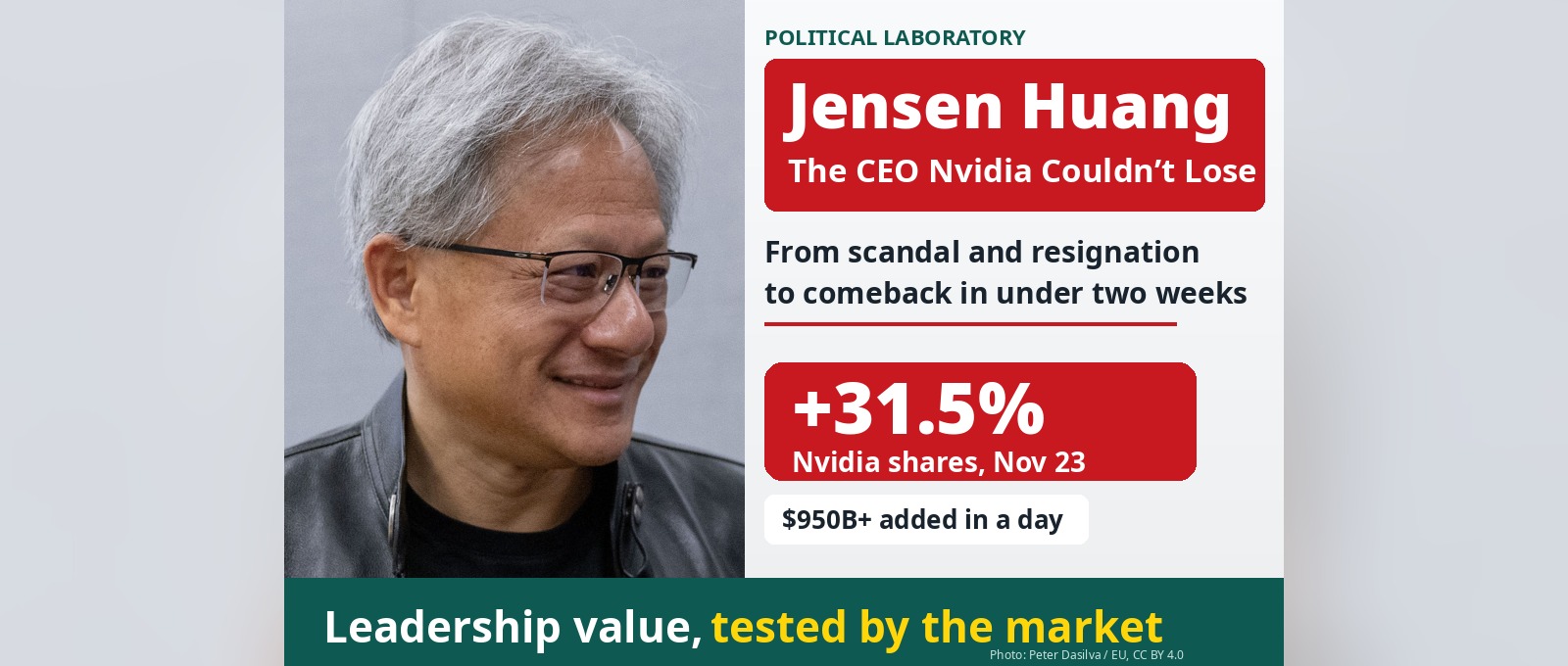
Nvidia shares surged 31.5% on November 23.
The stock closed at $165.05, compared with $125.53 on November 20. The rally added more than $950 billion to Nvidia's market capitalisation in a single trading session, according to Reuters.
This was not simply a reaction to the return of a CEO. It was a reaction to the return of confidence in a leader whose vision, execution and strategic decisions have become deeply intertwined with Nvidia's future.
Investors had not merely been betting on chips. They had been betting on Jensen Huang's ability to anticipate the next technological wave, build an ecosystem around it and persuade the world that Nvidia would remain at its centre.
The market's response suggested that, at least in the immediate aftermath of the crisis, investors believed there was no readily available substitute.
Is Jensen Huang bigger than the company?
That is the uncomfortable question Nvidia's board, shareholders and competitors may now have to confront.
Nvidia is one of the most valuable and consequential technology companies in the world. It has an extraordinary engineering workforce, enormous financial resources, a dominant position in AI computing and a global ecosystem that extends far beyond its hardware.
Yet its stock reacted as if the return of one individual had removed a systemic risk.
Huang is not simply a CEO who manages quarterly earnings. He is the architect of Nvidia's transformation from a graphics-chip company into the backbone of the modern AI infrastructure boom. His strategic bets on GPU computing, CUDA, accelerated computing, AI infrastructure and the ecosystem surrounding it helped position Nvidia at the centre of an industrial transformation.
His value is not just in what he knows about technology. It is in what he sees before others, how he allocates capital, how he mobilises talent and how he communicates a future that investors, customers and partners are willing to bet on.
Perhaps that is why Nvidia could not afford a prolonged leadership vacuum.
But the comeback also raises questions that the stock rally cannot answer. Can the board demonstrate genuine independence? Can the ongoing investigations resolve the concerns surrounding the allegations? Can Nvidia strengthen compliance, succession planning and corporate governance so that the company is not so vulnerable to the personal fortunes of a single executive?
A 31.5% rally is a powerful vote of confidence. It is not a verdict on the allegations, nor a substitute for accountability.
The ultimate lesson in leadership value
Jensen Huang's comeback may eventually be remembered as one of the most dramatic CEO reversals in modern corporate history.
Within days, he faced personal controversy, allegations with geopolitical implications, a resignation, uncertainty over his future and a board that initially appeared unwilling to bring him back. Yet the same company ultimately reversed its decision, and the market rewarded that reversal with one of the most spectacular single-day rallies in corporate history.
Perhaps his greatest achievement in this episode was not that he returned, but that the market demonstrated how much it believed Nvidia needed him.
When a company of Nvidia's scale, wealth and technological dominance is unable, or unwilling, to move forward without one individual, it says something extraordinary about the value of leadership, vision and institutional dependence.
It also says something potentially dangerous about corporate concentration of power.
Jensen Huang may have emerged as Nvidia's favourite again. But the real test of his second innings will be whether he can transform this comeback into a stronger company, one that retains his vision without becoming entirely dependent on his presence.
Because the true measure of a visionary is not merely how indispensable he becomes, but whether the institution he builds can endure beyond him.