Political Laboratory | Political Analysis
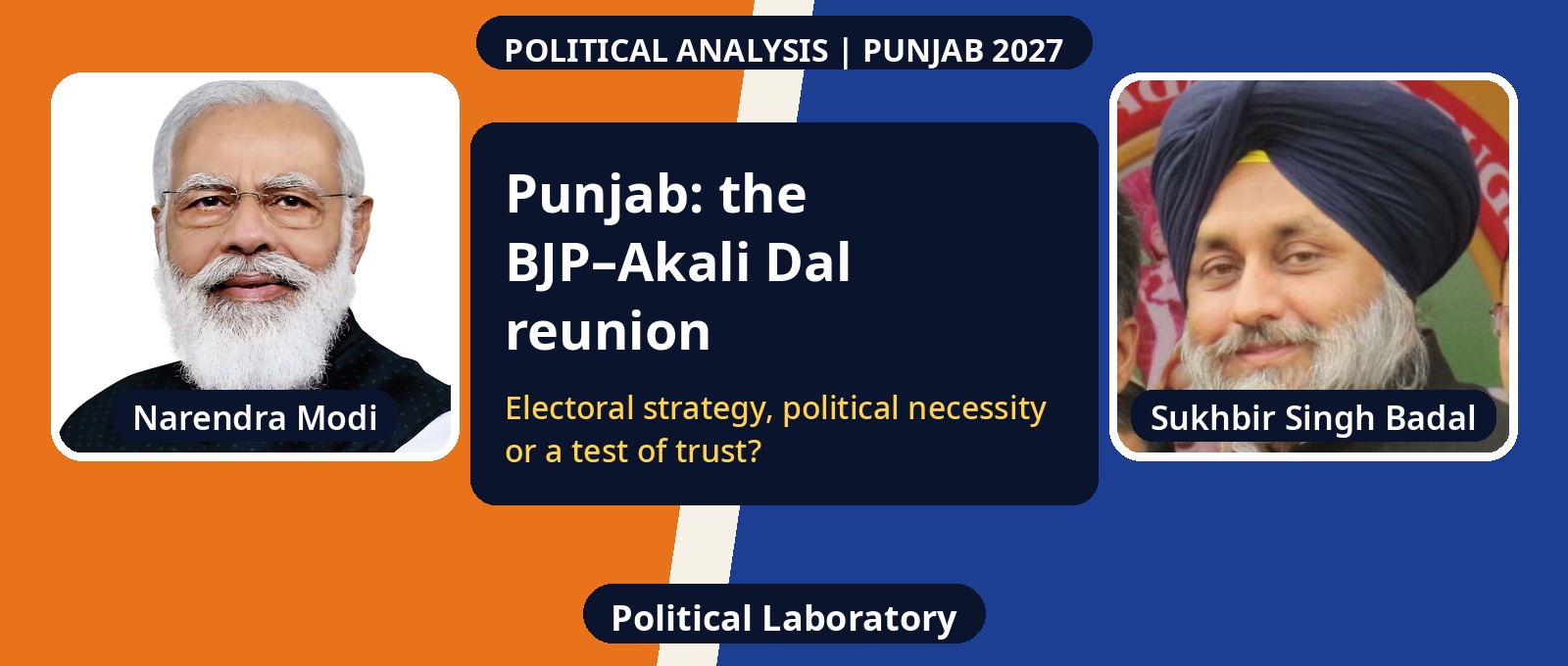
Punjab’s political landscape is witnessing a significant realignment with the Bharatiya Janata Party (BJP) and Shiromani Akali Dal (SAD) renewing their political partnership ahead of the 2027 Assembly elections. The reunion of two parties that once dominated Punjab’s electoral politics is more than an alliance announcement. It is a strategic attempt to overcome individual political limitations and reshape the state’s electoral arithmetic.
But can an old alliance recreate its old chemistry in a politically transformed Punjab?
A partnership broken by the farm movement
The BJP and SAD shared a long-standing political relationship built on complementary voter bases. While the Akali Dal had a strong rural and Sikh constituency, the BJP traditionally drew strength from urban voters and sections of the Hindu electorate. Their alliance offered both parties a broader electoral platform.
That partnership collapsed in 2020, when the Akali Dal exited the National Democratic Alliance over the controversial farm laws. Harsimrat Kaur Badal’s resignation from the Union Cabinet became a defining moment in the political separation.
The subsequent elections, however, exposed the limitations of both parties contesting independently. In the 2022 Punjab Assembly elections, BJP won just two seats, while SAD managed three. In the 2024 Lok Sabha elections, BJP failed to win a single seat despite increasing its vote share, while SAD secured just one constituency.
The renewed alliance, therefore, appears driven less by nostalgia and more by electoral necessity.
What does BJP gain?
For BJP, the Akali Dal offers something that money, national leadership and campaign machinery alone cannot easily build in Punjab: a deeply rooted regional political network.
The alliance could help BJP reconnect with rural constituencies, sections of Sikh voters and agricultural communities where the party has faced political resistance. The Akali Dal’s local organisational network could complement BJP’s national campaign infrastructure, resources and leadership.
Leaders such as Sunil Jakhar, Captain Amarinder Singh, Manpreet Singh Badal and Ravneet Singh Bittu could play important roles in shaping the BJP’s regional political narrative.
However, the alliance also comes with a risk. BJP has spent the last few years attempting to build an independent political identity in Punjab. A return to the old alliance formula could restrict its expansion if seat-sharing negotiations leave the party with a limited electoral footprint.
The BJP will also have to negotiate the political baggage associated with the Akali Dal’s previous governance and controversies.
Is the reunion an opportunity for SAD or a credibility challenge?
For the Shiromani Akali Dal, the alliance offers a potentially crucial opportunity to recover lost ground.
Sukhbir Singh Badal faces the challenge of rebuilding a party that has experienced electoral setbacks and criticism over governance, sacrilege-related controversies and the drug problem. An alliance with BJP could strengthen SAD’s electoral machinery, improve its access to urban voters and help it emerge as a more competitive force against AAP and Congress.
Yet the biggest challenge may be ideological and emotional rather than electoral.
SAD walked away from the NDA during the farm movement, presenting its departure as a stand in defence of farmers. Rejoining BJP inevitably raises questions among sections of the electorate about what has changed since 2020.
The party will need to convince voters that this alliance does not compromise its ability to represent Punjab’s agricultural interests, Sikh identity and regional aspirations.
The political figures and controversies that could shape Punjab
Punjab’s political contest is increasingly influenced by personalities and political narratives beyond traditional party structures.
Amritpal Singh’s electoral victory from Khadoor Sahib in 2024 demonstrated the appeal of alternative panthic political narratives among sections of the electorate. Sarabjeet Singh Khalsa’s victory from Faridkot also highlighted the potential for protest voting and the erosion of traditional political loyalties.
The political discussions surrounding Balwant Singh Rajoana, Sikh prisoner issues and the Dera Sacha Sauda leadership remain sensitive subjects in Punjab’s political environment.
Meanwhile, BJP leaders Ravneet Singh Bittu and Sunil Jakhar, among others, could be important voices in defending and promoting the renewed alliance. Their political positioning, local influence and ability to bridge political constituencies will matter as the campaign develops.
Five challenges that could determine the alliance’s success
Seat-sharing: BJP may seek a larger share than the traditional 23-seat Assembly arrangement. SAD may resist surrendering constituencies where it has historically been strong.
Farmers’ trust: The farm movement remains a politically sensitive chapter. Both parties will need a credible agricultural policy agenda rather than relying on alliance symbolism.
Sikh political representation: SAD must demonstrate that its alliance does not dilute its regional and panthic identity.
Drugs and governance: Both parties will likely campaign against Punjab’s drug problem, but SAD must also confront criticism associated with its own previous governments.
Internal coordination: Managing ticket aspirants, local rivalries, leadership expectations and campaign coordination will be a major organisational test.
2027: The real test of political chemistry
The BJP–Akali Dal reunion could potentially reshape Punjab’s electoral contest. BJP brings national leadership, organisational resources and an urban political base. SAD brings regional roots, traditional networks and a historical political presence across rural Punjab.
But electoral arithmetic alone does not guarantee victory.
The alliance must rebuild trust, resolve seat-sharing differences, develop a common policy agenda and persuade voters that the partnership represents a credible political alternative.
Punjab’s electorate has repeatedly demonstrated that political loyalties are not permanent. The farm movement, the rise of AAP and the electoral success of independent political personalities have all shown that established political arrangements can be challenged.
The reunion may bring two political organisations back together. Whether it brings their voters back together remains the central question of Punjab’s 2027 election.
Political Laboratory | Political Analysis
Cover portraits: Narendra Modi (official portrait, Government of India; source: Wikimedia Commons) and Sukhbir Singh Badal (Ministry of Youth Affairs and Sports, Government of India, 2014; source: Wikimedia Commons). Both licensed under the Government Open Data License - India (GODL-India).