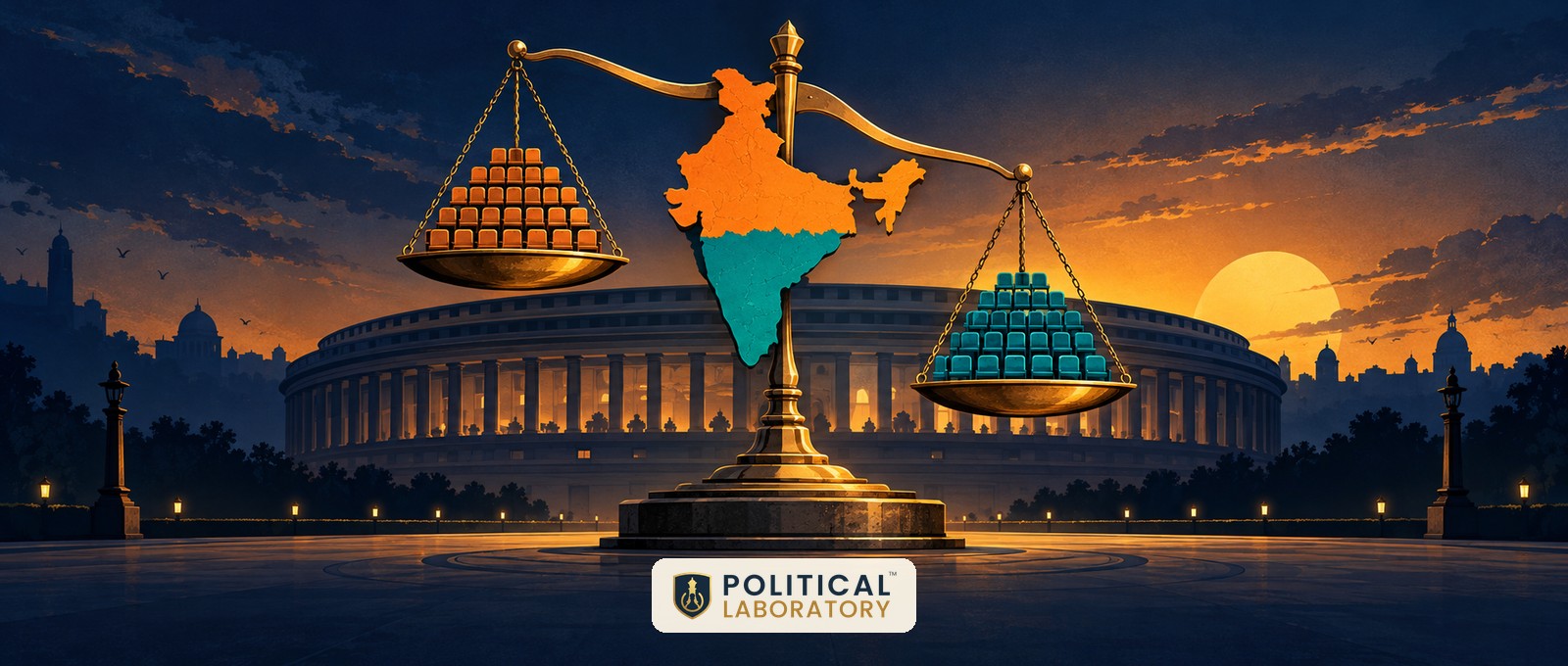
The delimitation debate in India is no longer just about redrawing constituency boundaries or increasing the strength of Parliament. It has evolved into a political contest over federal balance, electoral arithmetic, women's representation and the future relationship between India's northern and southern states.
The Centre's revised proposal to increase Lok Sabha seats by 50% across states, while maintaining their relative share of representation for the next 25 years, is an attempt to break the political deadlock that emerged during the earlier round of legislation. But the government's challenge remains the same: it needs a two-thirds majority to pass a constitutional amendment, and the numbers are far from comfortable.
The previous attempt failed in April 2026, with the Constitution Amendment Bill receiving 298 votes in favour and 230 against, falling short of the required special majority. The Union Cabinet has now cleared a revised proposal for the parliamentary sitting beginning November 30.
The numbers game: Who is backing the Bill?
The BJP-led NDA remains the principal supporter of the delimitation proposal. The BJP, along with its allies — Telugu Desam Party (TDP), Jana Sena Party and JD(U), among others — is backing the government's revised approach.
However, the Centre is actively looking beyond its alliance to secure the additional votes required for the constitutional amendment.
Several non-NDA parties have emerged as potential supporters, though most are attaching conditions.
YSR Congress Party (YSRCP): The party has indicated support, provided the formula ensures regional balance and a proportionate increase in representation for southern states.
NCP (Sharadchandra Pawar): The party has offered conditional support, insisting on a uniform 50% increase in seats across states.
DMK: Though historically one of the strongest opponents of population-based delimitation, the party formally announced its support for the revised bill on November 28, after Tamil Nadu's existing share of approximately 7.18% of Lok Sabha seats was protected and the relative proportions between states were frozen for 25 years.
Shiromani Akali Dal: Has reportedly moved towards supporting the proposal.
Some breakaway MPs from Trinamool Congress and Shiv Sena (UBT): Their changing political alignments could potentially benefit the government's numbers, although their voting position and parliamentary status remain important.
The Congress, Samajwadi Party, the Left parties, the principal Trinamool Congress leadership, RJD and AAP have opposed the earlier proposal and remain broadly opposed to the government's approach of linking women's reservation with a major parliamentary expansion and delimitation exercise.
The South Indian political divide
The real political battleground is likely to be southern India — not because every southern party opposes delimitation, but because the region has a fundamentally different political and demographic argument.
Southern states argue that they invested in education, healthcare, women's empowerment and family planning, resulting in comparatively lower population growth. They fear that a conventional population-based redistribution could reward states with higher population growth with greater political representation, while relatively reducing the influence of states that successfully stabilised their population.
The revised 50% increase formula is designed to address this fear, but it has not entirely resolved the political distrust.
Tamil Nadu
The DMK has been among the fiercest critics of population-based delimitation. DMK president and former Chief Minister M.K. Stalin has repeatedly argued that Tamil Nadu should not lose its relative parliamentary representation because of demographic differences.
The DMK's position, however, has shifted. On November 28, the party's MPs formally backed the revised bill after the safeguards it had sought, a protected 7.18% share and a 25-year freeze on the inter-state ratio, were accepted.
The TVK, led by Chief Minister Vijay, has opposed the delimitation exercise, while the AIADMK has taken a more supportive position, creating a political contrast within Tamil Nadu itself.
The DMK's support could prove decisive in the Lok Sabha.
Andhra Pradesh
Andhra Pradesh presents a considerably different political picture.
The ruling TDP and Jana Sena Party, both NDA partners, are expected to support the government's proposal. Their support is politically important because Andhra Pradesh has 25 Lok Sabha seats.
The YSRCP, despite being outside the NDA, has also indicated support, subject to safeguards ensuring regional balance and fair representation.
This means Andhra Pradesh may not become the primary battleground of opposition to delimitation. Instead, the state's political parties could become crucial contributors to the parliamentary arithmetic in favour of the legislation.
Telangana
Telangana's political position is more divided.
The Congress, which is in power in the state, has opposed the proposal in its earlier form, expressing concerns about federal representation and the implications of delimitation.
The BRS, on the other hand, has indicated conditional support, provided the South's existing share of roughly 24% in the Lok Sabha is protected.
Telangana's 17 parliamentary seats make it a relatively small but politically significant part of the southern representation debate.
Karnataka
Karnataka's ruling Congress has opposed the proposal, while the BJP and JD(S) are broadly aligned with the government's position.
Karnataka's political argument is similar to that of Tamil Nadu and Kerala: the state should not be disadvantaged for its demographic performance.
However, the BJP's presence and the JD(S)' alliance with the NDA make Karnataka a politically divided state on the delimitation issue.
Kerala
Kerala is among the states where opposition to the earlier Bill has been particularly strong.
The Congress-led political opposition and Left parties have argued that women's reservation should not be made dependent on delimitation. CPI and CPI(M) representatives have opposed the linkage between the women's quota and the proposed exercise.
Kerala's political consensus on the demographic argument is stronger than in some other southern states, though individual MPs and parties may differ on the broader constitutional question.
The Centre's counterargument: More seats for everyone
The government is attempting to neutralise the southern states' fears by proposing a uniform 50% increase in parliamentary seats.
Under the earlier model explained by Union Home Minister Amit Shah, the projected numbers were:
Lok Sabha: 543 to about 816 seats
Five southern states combined: 129 to 195 seats, still about 24% of the House
Andhra Pradesh: 25 to 38
Tamil Nadu: 39 to 59
Karnataka: 28 to 42
Telangana: 17 to 26
Kerala: 20 to 30
The government's argument is that a uniform increase would preserve the relative share of states while increasing the overall strength of Parliament. It also argues that a larger Lok Sabha would improve representation, reduce the burden on MPs and help implement the 33% women's reservation.
The political criticism, however, is that a uniform increase in seats may preserve percentages but not necessarily resolve the larger debate about the democratic weight of different states, the distribution of power within Parliament and the implications of future delimitation.
The revised proposal is therefore not simply a mathematical solution. It is an attempt to secure political trust.
What may happen in Parliament?
The government has a realistic opportunity to improve its numbers, but the outcome remains uncertain.
The earlier constitutional amendment received 298 votes in favour and 230 against. The government fell short of the required two-thirds majority.
The revised proposal has potentially altered the political arithmetic.
The YSRCP's support, the DMK's backing, the support of NCP(SP), and changing alignments among some opposition MPs could help the government narrow the gap.
But the DMK's 22 MPs are particularly important. With the party now backing the amendment after securing its safeguards, the political momentum has shifted significantly in the Centre's favour.
The NCP(SP), with its conditional support, could also become an important contributor.
The Congress-led opposition, meanwhile, is attempting to maintain unity and prevent the government from securing the required majority. The challenge for the opposition is that delimitation is not a conventional party-versus-party issue. Regional parties may negotiate independently based on their states' interests, making a unified opposition strategy harder to sustain.
The constitutional amendment will also have to clear the Rajya Sabha. The numbers in the Upper House are another hurdle, and a victory in the Lok Sabha alone will not guarantee the passage of the legislation.
The real question is not just delimitation
India is approaching a consequential moment in its parliamentary history.
The delimitation debate exposes a larger contradiction within the Indian federal system: should political representation be determined predominantly by population, or should the constitutional framework also recognise the developmental and demographic choices made by states over decades?
The North-South divide is not merely an electoral narrative. It is a debate about incentives, fairness, federalism and political power.
The Centre's revised formula may offer a compromise, but the final outcome will depend on whether regional parties believe the assurances are legally and politically durable.
If the government manages to secure the support of parties such as the DMK and YSRCP, the delimitation proposal could move forward with a broader political consensus than the previous attempt.
If it fails again, the government will be forced to reconsider the architecture of the proposed exercise, potentially separating women's reservation from delimitation or negotiating a more comprehensive federal agreement.
The biggest test for the Centre is no longer whether it can increase the number of seats in Parliament. It is whether it can convince India's states that a larger Parliament will not come at the cost of their political voice.