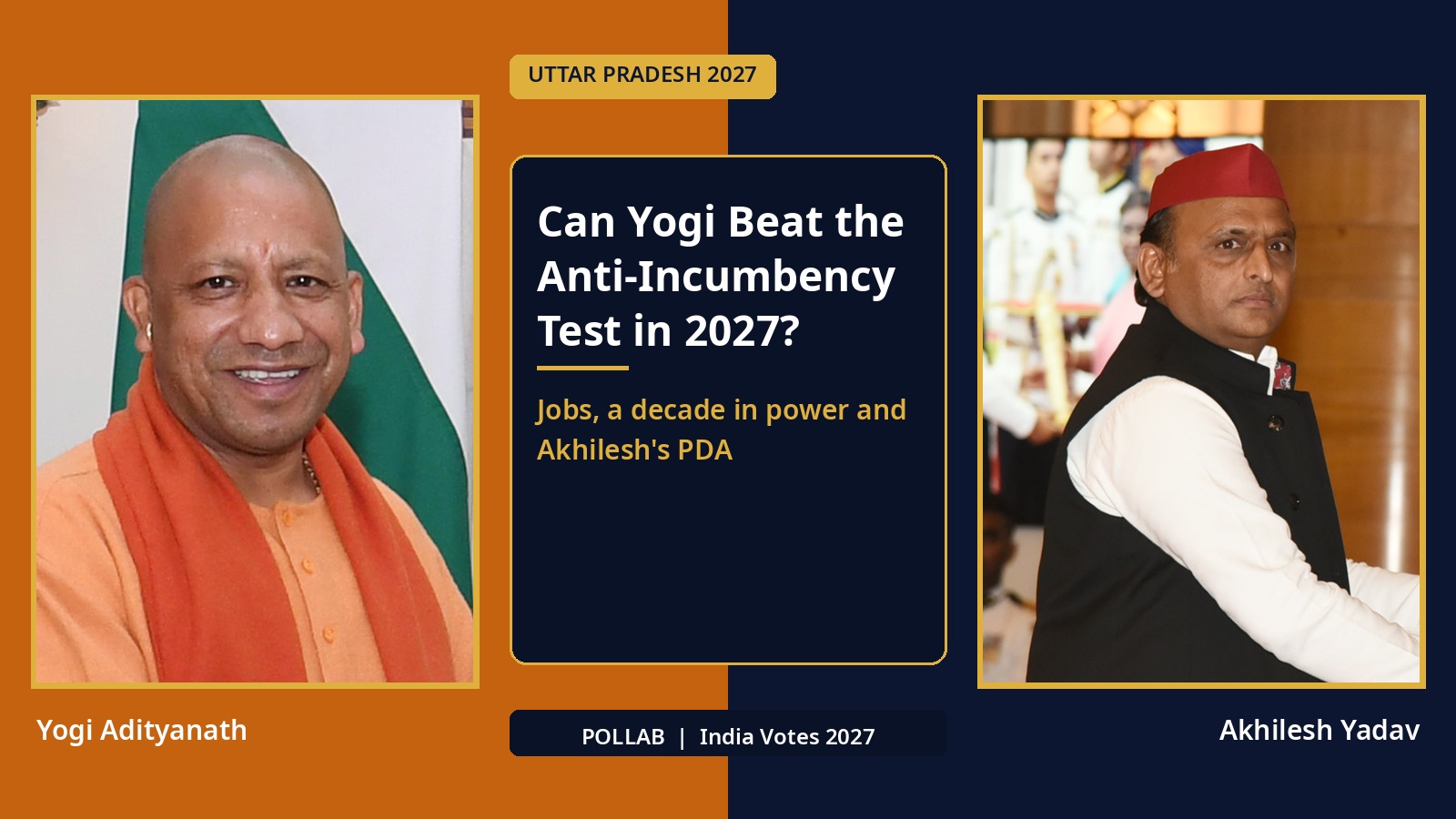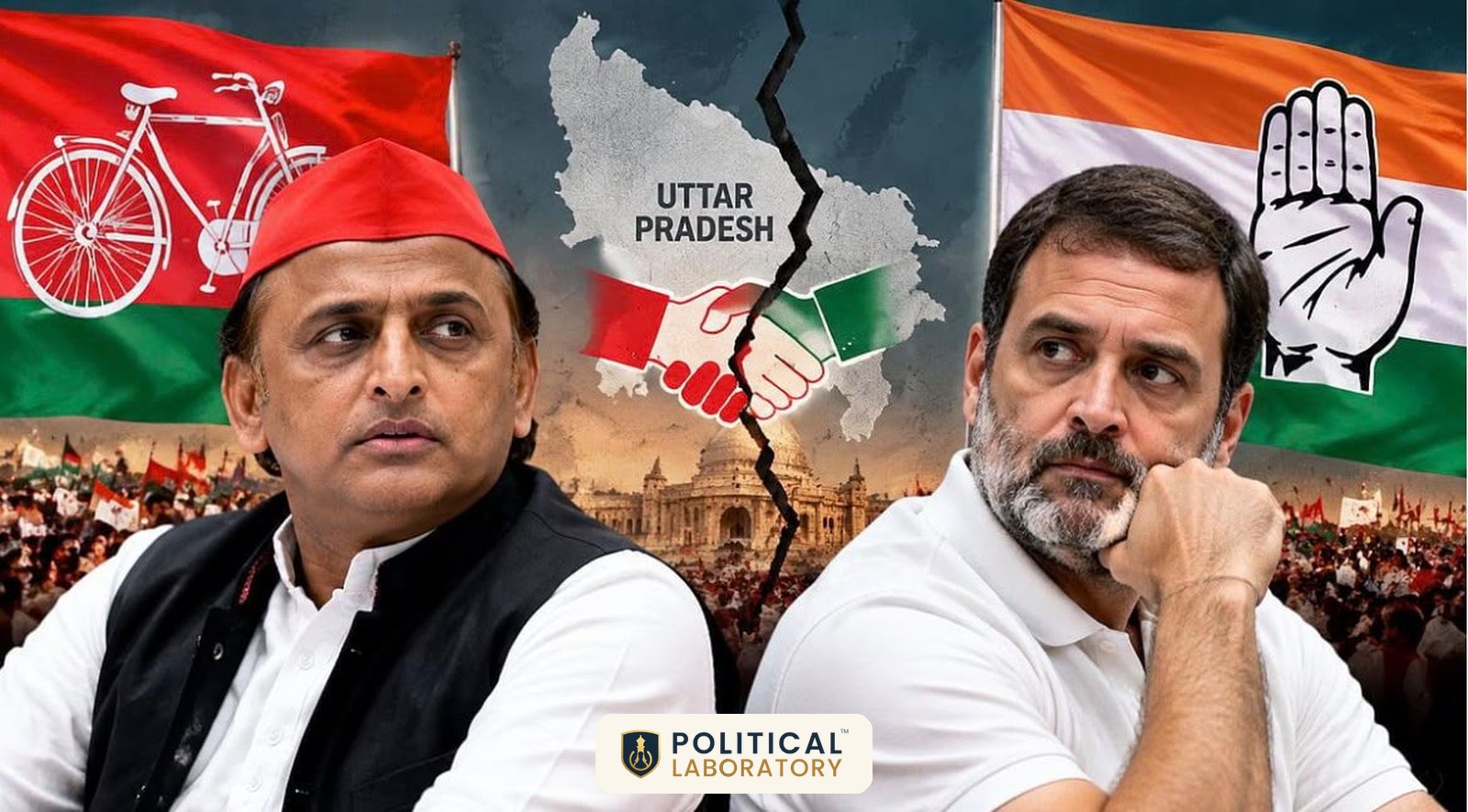
In Uttar Pradesh, the seat-sharing battle between Congress and Samajwadi Party is exposing a deeper struggle over political leadership, relevance and the future of opposition unity.
The INDIA alliance's battle in Uttar Pradesh has begun long before the election campaign, and the first battlefield is not against the BJP. It is across the negotiating table between the Congress and Samajwadi Party.
Congress reportedly entered the negotiations with ambitions of contesting around 120 seats in the 2027 Assembly elections. The Samajwadi Party's reported initial offer of 26 seats, however, has exposed just how far apart the two parties are in their assessment of each other's political worth.
This is not merely a dispute over constituencies. It is a battle over who gets to define the opposition's political hierarchy in Uttar Pradesh.
The SP's arithmetic versus Congress's ambition
Akhilesh Yadav's resistance is rooted in electoral arithmetic, organisational control and the political confidence he acquired after the 2024 Lok Sabha elections.
In the 2022 Uttar Pradesh Assembly elections, the Samajwadi Party won 111 seats with approximately 32% vote share. Congress, meanwhile, managed just two seats and around 2.33% of the vote. From the SP's perspective, those numbers make a demand for 120 constituencies difficult to justify.
But politics is not always a balance sheet of the previous election. Congress believes the 2024 Lok Sabha elections have changed its position. It won six seats in Uttar Pradesh, while the SP won 37, and the alliance collectively demonstrated that a coordinated opposition can challenge the BJP's dominance.
Congress therefore sees the 2024 result as a mandate for a stronger role in 2027. SP, however, sees the same result as validation of Akhilesh Yadav's PDA strategy, not necessarily a justification for expanding Congress's Assembly footprint.
That difference in interpretation is the core of the dispute.
Why Akhilesh is playing hardball
Akhilesh Yadav's reluctance to concede a large number of seats is not necessarily a sign that he wants Congress out of the alliance. It is an attempt to ensure that the SP remains the principal political force within the opposition coalition.
The SP's PDA strategy — bringing together backward communities, Dalits and minorities — has become the central pillar of Akhilesh's electoral calculations. He believes that the political architecture built around this coalition, coupled with the SP's organisational strength, can challenge the BJP in 2027.
Giving Congress 120 seats would mean relinquishing a substantial number of constituencies where SP aspirants, local leadership and party networks have been preparing for years.
There is also a strategic concern. Congress's revival in Uttar Pradesh is still uneven. Its six Lok Sabha victories in 2024 were significant, but they do not automatically translate into Assembly-level strength across 403 constituencies.
Akhilesh may therefore believe that Congress is negotiating from the momentum of a parliamentary election rather than from a demonstrated statewide Assembly organisation.
The 26-seat proposal: An offer or a political message?
The reported 26-seat proposal has become the symbol of the negotiations.
Congress reportedly considers the offer inadequate, especially given its ambition to rebuild in Uttar Pradesh and its desire to protect its traditional political territories, including Amethi and Rae Bareli.
But Akhilesh has attempted to shift the discussion away from rigid party-wise quotas.
In his recent public intervention, he urged Congress to identify additional winnable constituencies beyond the 26 seats already discussed. He proposed that the parties jointly evaluate candidates and constituencies, prioritising electoral viability over ownership of seats.
His preference for the terminology of "seat adjustment" rather than "seat distribution" is politically significant. He wants the alliance to be presented as a collective electoral project, with candidates chosen on the basis of winnability rather than party entitlement.
It is a clever negotiating strategy. Akhilesh is publicly positioning himself as flexible on candidates, while resisting a predetermined numerical quota.
Yet Congress may see the approach differently. A winnability-based process without a clear minimum allocation could leave it vulnerable to a negotiation in which the SP has greater constituency-level data, organisational leverage and bargaining power.
Congress's dilemma: Respect or realism?
It faces a difficult choice.
Accepting a very small allocation could undermine its revival narrative and reinforce the perception that it has become a junior partner dependent on regional parties in states where it once dominated.
Demanding 120 seats, however, risks creating the impression that Congress is prioritising political expansion over alliance arithmetic.
The party needs to demonstrate that its demands are based on constituency-level electoral potential, not merely on its national status or the political prominence of Rahul Gandhi.
Its strongest negotiating strategy would be to identify a carefully researched list of constituencies where it has a credible electoral base, strong candidates, identifiable voter coalitions and a realistic chance of winning. That would transform its demand from an aspirational number into a defensible political proposition.
Congress must also recognise that a respectable seat share is not necessarily a large seat share. A strategically selected 60–80 constituencies could be far more valuable than 120 seats where the party lacks the organisation to compete.
What happens next? Four possible outcomes
The negotiations could evolve in four broad directions.
A pragmatic compromise: SP offers approximately 55–80 seats, allowing Congress to protect its stronger constituencies while preserving SP's dominance.
Congress secures 80–100 seats following intervention by senior leadership and a constituency-based assessment of winnability.
Congress accepts 40–55 seats, provided the allocation includes strategically valuable constituencies and adequate campaign support.
The parties fail to agree, resulting in a fractured opposition, selective friendly contests or a wider alliance crisis.
The most plausible outcome is a negotiated compromise, rather than a complete breakdown, because both parties have electoral incentives to avoid dividing anti-BJP votes.
The larger INDIA alliance question
The Uttar Pradesh dispute is bigger than Congress and SP. It reflects a structural problem within the INDIA alliance.
Regional parties want national parties to recognise their state-level dominance. Congress, meanwhile, wants to rebuild its organisation and cannot indefinitely accept the role of a subordinate partner in states where it believes it has a revival opportunity.
The alliance has yet to establish a consistent framework for resolving these competing ambitions. In one state, Congress may be the dominant partner; in another, it may be negotiating with a regional party that has greater local strength. Without a credible mechanism for constituency evaluation, negotiations can become personality-driven, competitive and vulnerable to public posturing.
The BJP does not necessarily need the alliance to collapse. It only needs its partners to spend more time negotiating their political share than building a common electoral strategy.
The verdict
Akhilesh Yadav is negotiating to preserve the SP's dominance. Congress is negotiating to prevent its revival from being reduced to a symbolic presence.
Both positions are politically understandable. But neither can afford to turn negotiation into humiliation or entitlement.
The SP must recognise that a stronger Congress could contribute to a wider anti-BJP coalition. Congress must recognise that electoral momentum is not the same as constituency-level strength.
The real test of INDIA in Uttar Pradesh will not be whether Congress gets 26, 60 or 120 seats. It will be whether the alliance can turn competing ambitions into a common electoral strategy before the BJP turns those ambitions into its advantage.