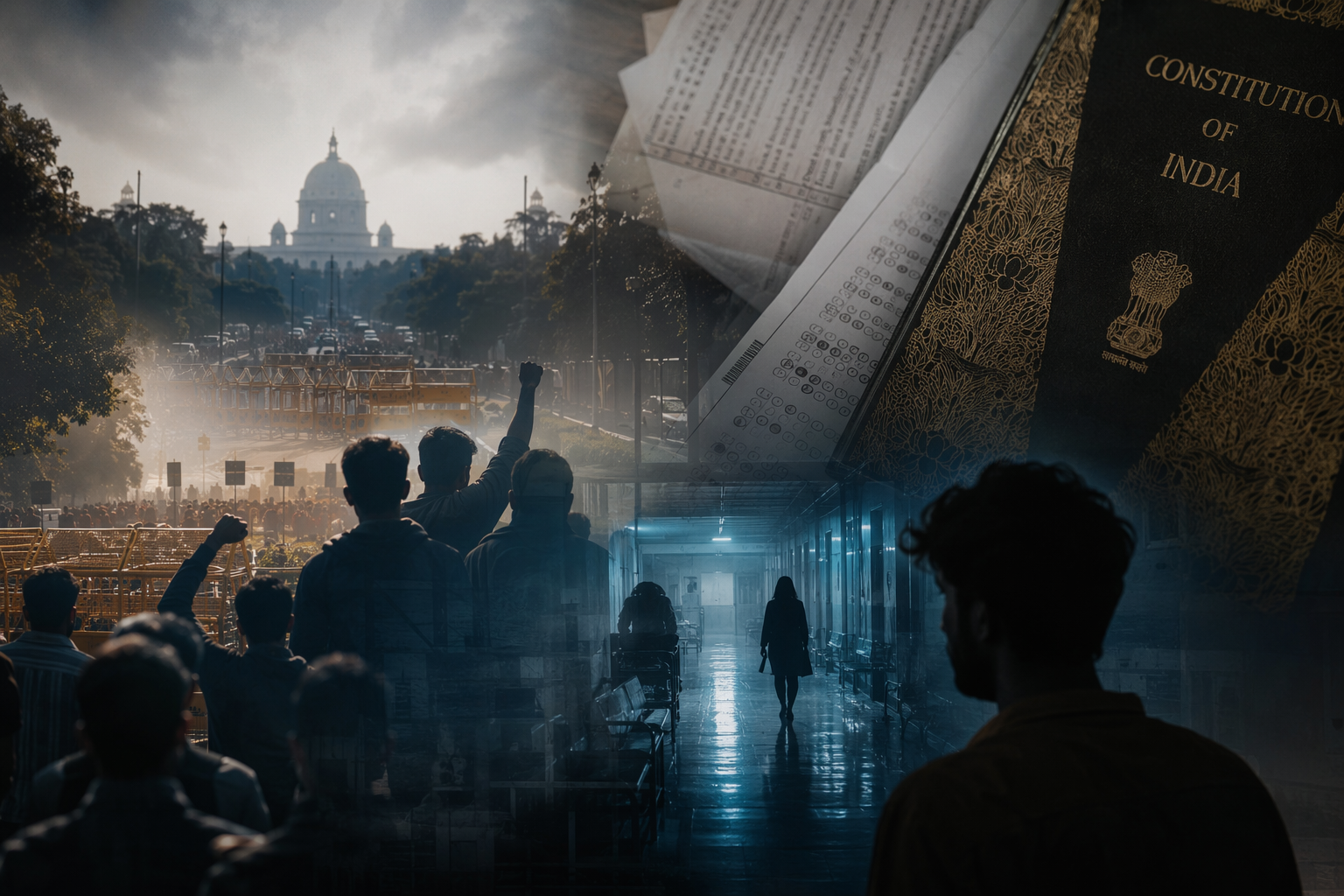
The CJP protest in New Delhi moved from internet-age satire to high-stakes street politics when thousands reportedly gathered at Jantar Mantar on July 20, 2026, for a march towards Parliament. The protest, framed by organisers around alleged NEET and examination irregularities, unemployment, education governance and demands for accountability, became a confrontation after police stopped the march in the high-security central Delhi zone.
The most reliable way to understand the episode is to separate what is established from what remains disputed. It is established through multiple reports that the mobilisation was large, that it attempted to move from Jantar Mantar towards Parliament, that police used force during the confrontation, that protesters and police personnel were injured, and that detentions were made. BBC reported at least 60 protesters wounded and, citing police, 118 police personnel injured. India Today reported more than 70 detentions and more than 100 injured security personnel. Those numbers differ and should not be converted into one definitive toll without official medical or police records.
It is also clear that the protest has acquired a national political life beyond its immediate organisers. Opposition figures were reported to have engaged with the aftermath, while the Union government and Delhi Police faced pressure to explain both the handling of exam-related grievances and the policing of a youth-led march. At the same time, police claims about stone-pelting, damage to police buses and violations of permissions need to be weighed against organiser allegations of excessive force and denial of peaceful assembly.
The CJP episode is significant because it sits at the intersection of three volatile issues in Indian politics: the credibility of competitive examinations, the shrinking patience of young job-seekers, and the state’s power to regulate protest in the national capital. It also shows how meme-driven movements can move quickly from online ridicule to physical mobilisation, especially when the underlying grievance is tied to education and employment.
What happened?
On July 20, 2026, CJP supporters gathered at Jantar Mantar in New Delhi for a planned march towards Parliament, widely referred to as Chalo Sansad. Jantar Mantar has long functioned as a designated protest site in the capital, but marches from there towards Parliament typically require strict police permission because the area falls within a sensitive security zone.
Early reports said thousands joined the mobilisation. The crowd was largely described as young, with students, job aspirants, online supporters and activists converging around allegations of examination irregularities and broader anger over unemployment. The protest drew attention partly because CJP’s identity was not that of a conventional student union or political party. It had grown through satire, memes and mockery of political language, including the provocative use of cockroach imagery as a symbol of survival, contempt for elite indifference and digital irreverence.
The march was stopped by police barricades as protesters attempted to move towards Parliament. BBC reported that police used tear gas and batons. Indian outlets including India Today and NDTV carried live updates describing detentions, injuries, hospitalisation and heightened security. Reports also referred to allegations of stone-pelting and damage to police vehicles, claims that require attribution to police or official sources unless independently verified.
The next day, July 21, the protest had not disappeared. Security remained tightened, political reactions intensified, and attention shifted to injured protesters, detained participants, FIRs, possible talks with government representatives, and court proceedings linked to hospitalisation and movement of individuals reportedly connected to the protest.
Timeline of the protest
The following chronology is based on available reported accounts and should be read with the labels attached to each entry. Where a claim is not independently verified, it is described as such.
Movement origin, reported by media: CJP emerged as a youth-led satirical political movement using internet culture, humour and anti-establishment language to mobilise around exam irregularities, unemployment and accountability.
Pre-July 20 mobilisation, claimed by organisers and reported by outlets: Organisers called supporters to gather at Jantar Mantar and march towards Parliament under the Chalo Sansad banner.
July 20, Jantar Mantar gathering, reported by BBC and Indian outlets: Thousands reportedly gathered in central Delhi. The crowd’s stated focus included alleged NEET 2026 irregularities, other examination concerns, unemployment and education governance.
July 20, attempted Parliament march, reported by media: Protesters attempted to move from Jantar Mantar towards Parliament. Police barricades and security restrictions blocked the march.
July 20, confrontation, reported by BBC: BBC reported that police used tear gas and batons. It also reported at least 60 protesters wounded and said police reported 118 personnel injured.
July 20, detentions, reported by India Today: India Today reported more than 70 detentions and more than 100 injured security personnel.
July 20, police allegations, police said or reported by outlets: Reports referred to police claims of stone-pelting, unlawful assembly and damage to police buses. These claims remain official allegations unless supported by independent evidence or court-tested records.
July 20 and 21, hospitalisations, reported by outlets: Injured protesters and security personnel were reported to have received medical attention. Comprehensive hospital bulletins or consolidated medical records were not available in the reporting base used here.
July 21, FIRs and investigation, reported by outlets: Reports referred to Delhi Police FIRs. The exact sections, accused persons and status of arrests or bail require confirmation from FIR copies, police statements or court records.
July 21, opposition visits or sit-ins, reported by live updates: India Today’s live coverage referred to opposition activity in response to the protest. Names, locations, detentions and exact statements should be verified from the concerned leaders’ official handles or on-record media reports before being treated as established fact.
July 21, reported talks or submissions, reported by live coverage: Reports referred to possible engagement with government representatives, including references to Union Minister JP Nadda. Without the text of an official statement or a confirmed memorandum, the content and status of such engagement remain provisional.
July 21, heightened security, reported by media: Security remained tightened in central Delhi, with the protest’s aftermath continuing around injuries, detentions, accountability demands and political reaction.
Why the protest started
The immediate trigger was anger over alleged examination irregularities, especially around NEET 2026, and broader claims about failures in education governance. Protesters also referred to concerns over CBSE online marking or OSM processes, though specific allegations require documentary evidence and official response before they can be treated as established facts.
Exam-related protests resonate deeply in India because competitive tests are not merely academic events. For millions of students, they are gateways to professional education, public-sector employment, family mobility and social status. A suspected paper leak or marking flaw can therefore be perceived not as an administrative mistake but as a theft of years of preparation.
The political sensitivity is compounded by unemployment. Young aspirants often spend years preparing for medical, engineering, government and public-sector examinations. When they believe the examination system is compromised, their anger is directed not only at a testing agency or board but at the state’s promise of fairness.
CJP’s satirical language helped turn that anger into a wider mobilisation. Satire can lower the entry barrier for young people who distrust formal politics but still want to express grievance. Memes, parody slogans and short videos can move faster than manifestos. In this case, that style appears to have helped CJP convert digital visibility into street presence.
Who is leading the movement?
CJP has been described in reports as a youth-led satirical political movement rather than a traditional party structure. Coverage has associated Abhijeet Dipke with the movement, including in connection with the Delhi protest. Some live pages spell the name differently, so biographical details and formal titles should be treated cautiously unless confirmed by CJP’s own verified communications or on-record interviews.
Reports and live updates have also mentioned names such as Saurav Das and Sonam Wangchuk in connection with the protest and its aftermath. NDTV’s live coverage included references to CJP, Abhijeet Dipke, Saurav Das, Sonam Wangchuk and Parliament protest developments. However, the exact role played by each individual should not be overstated without direct confirmation from official statements, verified interviews or court records.
The brief of available reporting also flags names such as Ashutosh Ranka and Gitanjali Angmo. In the absence of confirmed, credible reporting establishing their role in the July 20 mobilisation or July 21 aftermath, this article does not present their involvement as fact.
One of the striking features of the movement is that it does not rely solely on conventional leadership. Its online ecosystem, supporters, meme pages, student networks and local volunteer groups appear to play a significant role in mobilisation. This makes CJP harder to analyse through older models of student politics, where leadership hierarchies, union affiliations and party patronage were easier to map.
Main demands of the protesters
The demands attributed to protesters can be grouped into four broad categories.
Accountability for alleged exam irregularities: Protesters have focused on alleged NEET 2026 paper leak claims and other examination concerns. These remain allegations unless confirmed by investigative findings, court records or official admissions.
Education governance reform: Protesters have raised broader questions about testing systems, marking processes, transparency and grievance redressal.
Political accountability: Reports say CJP demanded the resignation of Union Education Minister Dharmendra Pradhan. This is presented as a reported protest demand, not as an assessment of ministerial responsibility.
Jobs and youth justice: The movement has linked exam credibility to unemployment, arguing that young Indians cannot trust a system in which recruitment and education pathways appear vulnerable to leak allegations or administrative error.
There were also reports of a memorandum or submission of demands to government representatives, including references to Union Minister JP Nadda. At the time of writing, the exact text, whether it was formally received, and what response was given should be verified from official records or direct statements by the concerned office.
Government response
The Union government’s response must be separated into two tracks: the response to examination-related allegations and the response to the Delhi protest.
On the examination track, any official position by the Union Education Ministry, testing authorities or other government bodies should be read from their formal statements. This article does not rely on unattributed social media claims to determine whether a NEET 2026 paper leak or CBSE OSM issue occurred. The protesters’ allegations are politically significant, but factual determination requires investigation, records and institutional response.
On the protest track, the visible state response came through Delhi Police security arrangements, barricading, crowd control and reported detentions. Because Delhi Police functions under the Union Home Ministry, policing in central Delhi often becomes politically sensitive, especially when a march is directed towards Parliament during a parliamentary session or a high-security period.
BJP leaders or Union ministers may have issued statements in live updates or press interactions, but statements should be cited only where the text and source are available. The available reporting base for this analysis does not support attributing specific words to ministers beyond the reported existence of government engagement and the protesters’ demand directed at the Education Minister.
Police action and security measures
Delhi Police faced the operational problem of managing a large crowd at Jantar Mantar, a designated protest zone, while preventing an unauthorised or restricted march towards Parliament. Police permission systems in central Delhi usually specify location, duration, crowd size, route and prohibited areas. A breach of those conditions can trigger barricading, dispersal orders, detentions and FIRs.
BBC reported that police used tear gas and batons during the July 20 confrontation. India Today reported more than 70 detentions and more than 100 injured security personnel. BBC reported that police said 118 personnel were injured. These figures may reflect different reporting times, definitions and sources.
Police claims reported by outlets included allegations of stone-pelting and damage to police buses. Such claims are consequential because they can shape FIR sections, bail conditions and public perception. But they must be separated from proven facts. A police allegation is an official claim, not a judicial finding.
Organisers and supporters, in turn, alleged excessive force and argued that the protest was a legitimate expression of youth anger over exam irregularities. Videos circulating online appeared to show chaotic crowd-control scenes, but video clips can omit context, sequence and provocation. Responsible analysis requires full footage, timestamps, medical records, police logs and independent witness accounts.
What is disputed?
Numbers: Injury and detention counts differ. BBC reported at least 60 protesters wounded and police claims of 118 injured personnel. India Today reported more than 70 detentions and more than 100 injured security personnel.
Responsibility for escalation: Police accounts reportedly referred to stone-pelting and damage. Protesters alleged excessive police force. Neither narrative should be treated as complete without independent evidence.
Permissions and route: The precise permissions granted, if any, and whether organisers violated route conditions require police orders or permission letters.
Exam allegations: The protest was driven by alleged NEET 2026 and other examination irregularities, but those allegations require official investigation and documentary proof.
Political involvement: Reports of opposition visits, sit-ins or detentions require verification by name, location and statement before being treated as established.
Court proceedings
Legal proceedings became part of the aftermath because of hospitalisation, detentions and possible police cases. NDTV reported that the Delhi High Court allowed Sonam Wangchuk to be moved from Safdarjung Hospital to Medanta. The exact language of the order, the case context, who moved the court, and whether the direction was medical, custodial or procedural in nature should be verified from the court record before drawing conclusions.
Reports also referred to FIRs by Delhi Police. FIR details matter because the sections invoked determine the legal trajectory of the case. Allegations such as unlawful assembly, rioting, obstruction of public servants, damage to public property or assault on police personnel carry different evidentiary burdens and bail implications. Without copies of FIRs or court filings, it is premature to state which participants face which charges.
If detentions were preventive, the legal issues would differ from formal arrests. Preventive detention during a protest may be used to stop an anticipated breach of peace, while arrest under an FIR follows allegations of specific offences. Families, lawyers and rights groups often seek production, medical examination, bail or quashing remedies depending on the facts.
Political reactions
The protest quickly moved into the national political arena because it combined youth anger, education policy, Parliament-adjacent symbolism and police force. Opposition leaders were reported in live updates to have engaged with injured protesters or reacted to the crackdown, including references in India Today’s coverage to opposition activity on July 21. However, names such as Rahul Gandhi, Priyanka Gandhi Vadra, Akhilesh Yadav and Arvind Kejriwal should be included only where their statements, locations and actions are verified from credible reports or their official communications.
For opposition parties, the issue offers a familiar but potent frame: exam integrity, youth unemployment and state response to dissent. For the government, the political challenge is twofold. It must avoid appearing indifferent to students while also defending the security logic of restrictions near Parliament.
The political risk for all sides is overreach. If the opposition treats every police action as proof of authoritarianism without addressing violence allegations, it may alienate citizens concerned about public order. If the government treats a student-heavy protest primarily as a law-and-order problem, it risks deepening mistrust among young voters.
Public response
Public response has been divided but intense. Among students and aspirants, the protest drew sympathy because exam credibility is a personal issue. Even those not aligned with CJP may see examination irregularities as a direct threat to fairness.
Residents and commuters in central Delhi may have viewed the protest through a different lens: traffic disruption, security cordons and uncertainty around Parliament-area movement. In Delhi, large protests often create a clash between democratic visibility and daily inconvenience.
Parents, teachers and coaching communities are likely to be important opinion shapers. If they believe the exam allegations are credible, pressure on the government will grow. If the movement becomes associated mainly with confrontation, property damage or unclear leadership, broader support may become more cautious.
Social media impact
CJP’s rise cannot be understood without social media. The movement’s language appears designed for platforms where satire, short clips and provocative symbols can travel faster than policy papers. The cockroach motif, uncomfortable as it may be for traditional politics, works because it conveys survival, disgust and mockery in one image.
Hashtags linked to the protest amplified clips from Jantar Mantar, videos of police action, injury claims, calls for accountability and counter-claims about violence. As with most fast-moving protests, the online record is uneven. Some clips may be authentic but incomplete. Some claims may be exaggerated. Some accounts may be partisan or automated.
Reports also referred to Delhi Police probing Pakistan-linked social media handles. This should be treated as an investigative claim unless supported by police statements, platform data or case records. Foreign amplification, if proven, would be relevant to information security. But it would not by itself settle the legitimacy of domestic grievances over exams and unemployment.
India Today’s coverage referred to internal controversy around CJP spokesperson Vijeta Dahiya after a viral Burger King video. If verified from credible reporting, such an episode would matter because it shows that the movement is also under pressure to police its own public image and internal accountability. It should not, however, be allowed to distract from the larger public questions unless it directly affects leadership credibility or protest conduct.
Legal and constitutional aspects
The Constitution protects speech and peaceful assembly, but it does not create an unrestricted right to march anywhere at any time. Article 19(1)(a) protects freedom of speech and expression. Article 19(1)(b) protects the right to assemble peacefully and without arms. Articles 19(2) and 19(3) allow reasonable restrictions in the interests of public order, sovereignty and integrity of India, and other specified grounds.
The practical question in protest policing is proportionality. Did the authorities have a lawful basis to restrict the march? Were restrictions communicated clearly? Was the crowd given warnings? Was force used only when necessary and in proportion to the threat? Were injured persons given medical care? Were detainees informed of grounds and allowed access to lawyers and families?
Supreme Court jurisprudence has repeatedly tried to balance protest rights with public order. In the Ramlila Maidan case, the Court examined police action against a sleeping crowd and emphasised the importance of proportionality and restraint. In Mazdoor Kisan Shakti Sangathan v Union of India, the Court recognised the need to balance protest at Jantar Mantar with the rights of residents and state concerns. In the Shaheen Bagh judgment, Amit Sahni v Commissioner of Police, the Court held that public ways cannot be occupied indefinitely, while still recognising dissent as part of democracy.
Applied to the CJP protest, the legal assessment will depend on evidence. A peaceful assembly that was dispersed with unnecessary force raises one set of constitutional questions. A march that turned violent, attacked police or damaged public property raises another. It is possible for both concerns to coexist: protesters may have legitimate grievances, and police may still have a duty to prevent entry into a restricted zone.
Impact on students and citizens
For students, the protest has immediate and long-term effects. The immediate effect is fear, especially among those injured, detained or named in police cases. The long-term effect is political socialisation. Many young participants may remember this protest as their first direct encounter with the state.
For aspirants, the central issue remains examination credibility. If the government does not address the underlying allegations with transparent processes, protests may continue even if the street confrontation is contained. Students want clear answers: Was there a leak? Were marking systems audited? Were grievances heard? Who is accountable if irregularities occurred?
For citizens in Delhi, the episode raises familiar questions about protest management. Central Delhi is both a symbolic democratic space and a security-sensitive administrative zone. When Parliament is the target of a march, the symbolic stakes rise, but so do restrictions.
For political parties, the protest is a signal that youth anger can mobilise outside traditional student wings. Satirical formations may be dismissed as unserious until they put thousands on the street. By then, the cost of ignoring them can be high.
Possible next developments
Several developments are likely in the days ahead.
Negotiations or formal submissions: If organisers submit demands to government representatives, the content and official response will shape the next phase.
Police investigation: FIRs, video analysis, identification of alleged stone-pelting and bail proceedings may continue.
Medical documentation: Hospital records and injury reports could clarify the scale and nature of injuries on both sides.
Court oversight: Courts may hear petitions on medical transfer, detention, bail, police action or protest permissions.
Education ministry response: A detailed response to exam irregularity allegations could reduce pressure, while silence may extend the protest cycle.
Parliamentary debate: Opposition parties may try to raise the issue in Parliament, especially if the protest remains visible nationally.
Further protests: CJP and allied student groups may call more demonstrations, depending on detentions, injuries and government engagement.
Information investigations: Police or agencies may examine viral content, alleged misinformation and claims of foreign-linked amplification.
The central test will be whether the issue moves from confrontation to evidence. Protesters must substantiate allegations and maintain non-violent discipline. The state must answer examination concerns transparently and justify any police force with records, not broad assertions.
Frequently Asked Questions
What is CJP?
CJP is described in current coverage as a youth-led satirical political movement that uses humour, meme culture and anti-establishment messaging. It has mobilised around alleged exam irregularities, unemployment and accountability demands.
What was the July 20 Chalo Sansad march?
It was a protest mobilisation from Jantar Mantar towards Parliament in New Delhi on July 20, 2026. Reports said thousands participated and police stopped the march in the high-security central Delhi zone.
Why were students protesting?
Protesters cited alleged NEET 2026 paper leak concerns, other examination irregularities, education governance issues and unemployment. These are protest allegations unless confirmed by official investigation or court records.
How many people were injured?
Counts differ. BBC reported at least 60 protesters wounded and said police reported 118 personnel injured. India Today reported more than 100 injured security personnel. A consolidated official medical figure was not available in the reporting base used here.
How many people were detained?
India Today reported more than 70 detentions. The legal status of each person, whether preventive detention, arrest or later release, requires confirmation from police or court records.
Did police use force?
BBC reported that police used tear gas and batons. Other outlets reported lathi charge or baton use. Police are expected to justify force through crowd-control procedure, warnings and proportionality.
Did protesters attack police?
Reports referred to police allegations of stone-pelting and damage to police buses. These are official claims unless independently verified or established in court.
Was there a court order involving Sonam Wangchuk?
NDTV reported that the Delhi High Court allowed Sonam Wangchuk to be moved from Safdarjung Hospital to Medanta. The precise order, case context and court language should be verified from the court record.
Did the government meet the protesters?
Live updates referred to reported talks or submission of demands to government representatives, including references to Union Minister JP Nadda. The status and content require confirmation from official statements or the memorandum itself.
Is the right to protest absolute?
No. The Constitution protects peaceful assembly and speech under Article 19, but the state may impose reasonable restrictions for public order and security. The legality of restrictions and force depends on facts and proportionality.
What happens next?
The next phase may include police investigations, bail or detention matters, medical documentation, court proceedings, government response to exam allegations, parliamentary debate and possible further protests.
Conclusion
The CJP protest is not only a story about one march in New Delhi. It is a test of how India handles youth anger when the grievance is tied to exams, jobs and trust in public institutions. The July 20 confrontation showed the speed with which online satire can become physical mobilisation. The July 21 aftermath showed how quickly a protest can become a national accountability question.
The facts that matter most are still being assembled: who was injured, who was detained, what the FIRs allege, whether force was proportionate, what the protesters formally demanded, and how the government will respond to the underlying examination concerns. Until those records are clear, certainty would be premature.
A democratic response requires two forms of discipline. Protesters must keep their movement peaceful and evidence-led. The state must distinguish between managing security and suppressing dissent, and it must address education grievances with transparency rather than procedural opacity.
The likely next developments are negotiations, court oversight, police investigations, parliamentary pressure and a possible education ministry response. The deeper consequence may be political. If young Indians conclude that formal channels do not hear them, satire will keep turning into street mobilisation. If institutions respond credibly, the confrontation may yet become an opportunity to rebuild trust.